Puerto Princesa ([ˌpwɛɾ.to pɾɪnˈsɛ.sɐ]), officially the City of Puerto Princesa (Cuyonon: Siyudad i'ang Puerto Princesa; Filipino: Lungsod ng Puerto Princesa), is a highly urbanized city in the Mimaropa region of the Philippines. According to the 2020 census, it has a population of 307,079.
It is a city located in the western Philippine province of Palawan and is the westernmost city in the Philippines. Though the seat of government and capital of the province, the city itself is one of 38 independent cities within the Philippines not controlled by the province in which it is geographically located and is therefore an independent area located within Palawan for its geographical and statistical purposes by the Philippine Statistics Authority. It is the largest city in the province of Palawan and the Mimaropa region.
It is the least densely populated city in the Philippines with 110 inhabitants per square kilometer (280 inhabitants/sq mi). In terms of land area, the city is the second largest geographically after Davao City with an area of 2,381.02 square kilometers (919.32 sq mi). Puerto Princesa is the location of the Philippines' Western Command headquarters.
Today, Puerto Princesa is a tourist city with many beach resorts and seafood restaurants. It has been acclaimed several times as the cleanest and greenest city in the Philippines.
Etymology
The name Puerto Princesa has several possible origins. It is said to have been attributed by locals to a princess-like maiden who roams the place on certain nights of the year, while other accounts attribute its geographical advantage as a seaport which is a naturally protected area due to its surrounding mountains, and is characterized by a depth able to accommodate any size of shipping vessel.
There are two official versions about the actual origin of the name. The first is that place was originally named Port of the Princess (Spanish: Puerto de la Princesa) after Infanta Eulalia, one of the princesses born to Isabella II of Spain and her consort, Francis, Duke of Cádiz Another version, however, states that the place was originally named Port Asuncion (Spanish: Puerto de Asunción), allegedly named after another daughter of Isabella II and the Duke of Cadiz. In this version, the princess suffered an untimely death, which prompted the Queen to change the name to Puerto de la Princesa, and was eventually shortened to Puerto Princesa. However, this second version is likely to be incorrect, as Isabella and Francis did not have a daughter named Asunción.
History
Spanish period
Spanish colonists founded the settlement on March 4, 1872, in the course of their exploration of the province. As they scanned the Palawan shoreline for a capital site, they came upon a hill with steep declivity. Rowing to shore, they surveyed the hill and discovered an extensive plateau which they decided as ideal for settlement.
Soon after, Fr. Antonio Muro levelled a portion of the hill to make way for a chapel (that section is now occupied by the Roman Catholic Cathedral, the P.C. Barracks and the Rizal Park, the Old Municipal Building used to be there, as well as an Elementary School). The first mass celebrated in Puerto Princesa took place at a site where a marker now stands.
In May 1872, the Port of Puerto Princesa became the center of Spanish naval operations in the area because the Bay met all the navy's requirements. Royal decrees later provided incentives to settlers, and by 1883 the settlement had flourished into a town of twelve roads, a hospital and well-built port.
In 1894, Puerto Princesa was recognized by government authorities as one of the most beautiful towns in the country by virtue of the orderly distribution of streets, buildings and houses as well as the cleanliness of the community.
American period and World War II
In 1911, the New American Administration made Puerto Princesa the seat of the Palawan Provincial Government with Major John Brown as Lieutenant Governor.
In the year 1936, Governor Heginio Mendoza made a directive on the transfer of the Palawan High School (currently Palawan National School) from the island municipality of Cuyo to the central place of the province, which was the Municipality of Puerto Princesa.
During the Pacific campaign of World War II and the Japanese occupation, the village was largely abandoned. On May 18, 1942, Japanese troops landed and occupied Puerto Princesa City.
The Filipino Constabulary barracks was the scene of the Palawan Massacre, just before liberation with the allied Invasion of Palawan.
Post-World War II
In 1951, the barrios of Tinitian, Caramay, Rizal, Del Pilar, Malcampo, Tumarbong, Taradungan, Ilian, and Capayas were separated to form the town of Roxas.
In 1955, the sitios of Materingen, Tandayag, Nasedoc, and Panlawagan were separated from the barrio of Maroyogon and elevated into a barrio.
In 1956, the sitios of Calagbenguen, Tarabanan, Bendoyan, Talabigan, Tagbuan, and Langogan were constituted into the barrio of Concepcion.
In 1957, the barrio of Tapul was renamed to Salvacion.
Cityhood
The town was converted into a city on January 1, 1970, under Republic Act 5906 as amended by P.D. 437, through the effort of then Congressman Ramon Mitra, Jr. Feliberto R. Oliveros, Jr., who then became the first City Mayor. In 1987, the port of Puerto Princesa was put under the administration of the Philippine Ports Authority, expanding the city's importance nationally and advancing its infrastructure.
Highly urbanized city
On March 26, 2007, through Proclamation No. 1264, the city of Puerto Princesa was converted into a highly urbanized city. A plebiscite was held on July 21, 2007, where majority of residents voted in its favor. In 2011, the President launched a nationwide campaign for the inclusion of Puerto Princesa's underground river into the New Seven Wonders of Nature. This campaign came into fruition when the Puerto Princesa Subterranean River National Park, the city's top heritage site, was recognized internationally as one of the New Seven Wonders of Nature in 2012.
Contemporary
In May 2001, Abu Sayyaf gunmen entered the luxury Dos Palmas Resort in Honda Bay just off the coast of Puerto Princesa and kidnapped 20 people from the resort, including four resort staff and three Americans.
On the morning of January 24, 2011, broadcast journalist and former politician Gerry Ortega was at an "ukay-ukay" (used clothing) thrift store in Puerto Princesa when he was murdered by a gunman. After a brief chase, police apprehended the alleged shooter, Marlon Recamata, who confessed to the crime at the Puerto Princesa Police Office and implicated three other persons. In 2015, former Palawan governor Mario Joel Reyes was arrested in Thailand after being charged by the city court in connection with the crime. Various courts went back and forth in ordering the arrest or non-arrest of Reyes, with him being released from jail in 2018 upon orders of the Court of Appeals but ultimately ordered rearrested in 2023, with him surrendering to the National Bureau of Investigation in Metro Manila in September 2024.
Geography
Puerto Princesa is located in the mid-section of Palawan Island. It is bound to the east by the Sulu Sea, to the west by the South China Sea, to the north by the municipalities of San Vicente and Roxas, and to the south by the municipality of Aborlan. It is approximately 306 nautical miles (567 km) from the Philippine capital of Manila, 205 nautical miles (380 km) from Panay and 250 nautical miles (460 km) from Zamboanga City on the southern Philippine island of Mindanao.
Barangays
Puerto Princesa is politically subdivided into 66 barangays. Each barangay consists of puroks and some have sitios.
These barangays are grouped into two districts. Currently, there are 35 barangays of which are classified as urban barangays.
Climate
Puerto Princesa features a tropical wet and dry climate (Köppen climate classification Aw). It is usually wet from May to December, with very little rain from January to April. Average temperature is 27.43 °C (81.37 °F) while the annual average rainfall is 1,563.8 millimetres (61.57 in) per year. It is warm and humid all year round.
Demographics
In the 2020 census, the population of Puerto Princesa was 307,079 people, with a density of 130 inhabitants per square kilometer or 340 inhabitants per square mile.
Waves of migrants from other Philippine provinces, and even other countries, have turned Puerto Princesa into a melting pot of various cultures. Among the original inhabitants are the Cuyonons who have a rich legacy of folklore and traditions. Indigenous groups include the Tagbanwas, Palawanos, Molbogs and Bataks, each group with its distinct culture and system of beliefs.
Total inhabitants number 307,079 (as of 2020), of which three-quarter of the population resides in the city proper, an urban settlement on the shores of Puerto Princesa Bay. Although the predominant language is Tagalog, Cuyonon is widely spoken and used throughout the whole city, as well as Hiligaynon, other Visayan languages, and English.
Economy
Poverty incidence of Puerto Princesa
Puerto Princesa is known as the "Eco-Tourism Center of the Philippines". In recent years, the city has seen an increase in the number of tourists bringing with them trade and businesses for the city. Many hotels ranging from basic to five-star luxury accommodations have been developed since the 1990s to cater to a growing number of foreign and local tourists in the city.
There are also a number of restaurants, bars and shopping malls, including the Robinsons Place Palawan, NCCC Mall Palawan, Unitop Mall Puerto Princesa, as well as the recently opened SM City Puerto Princesa.
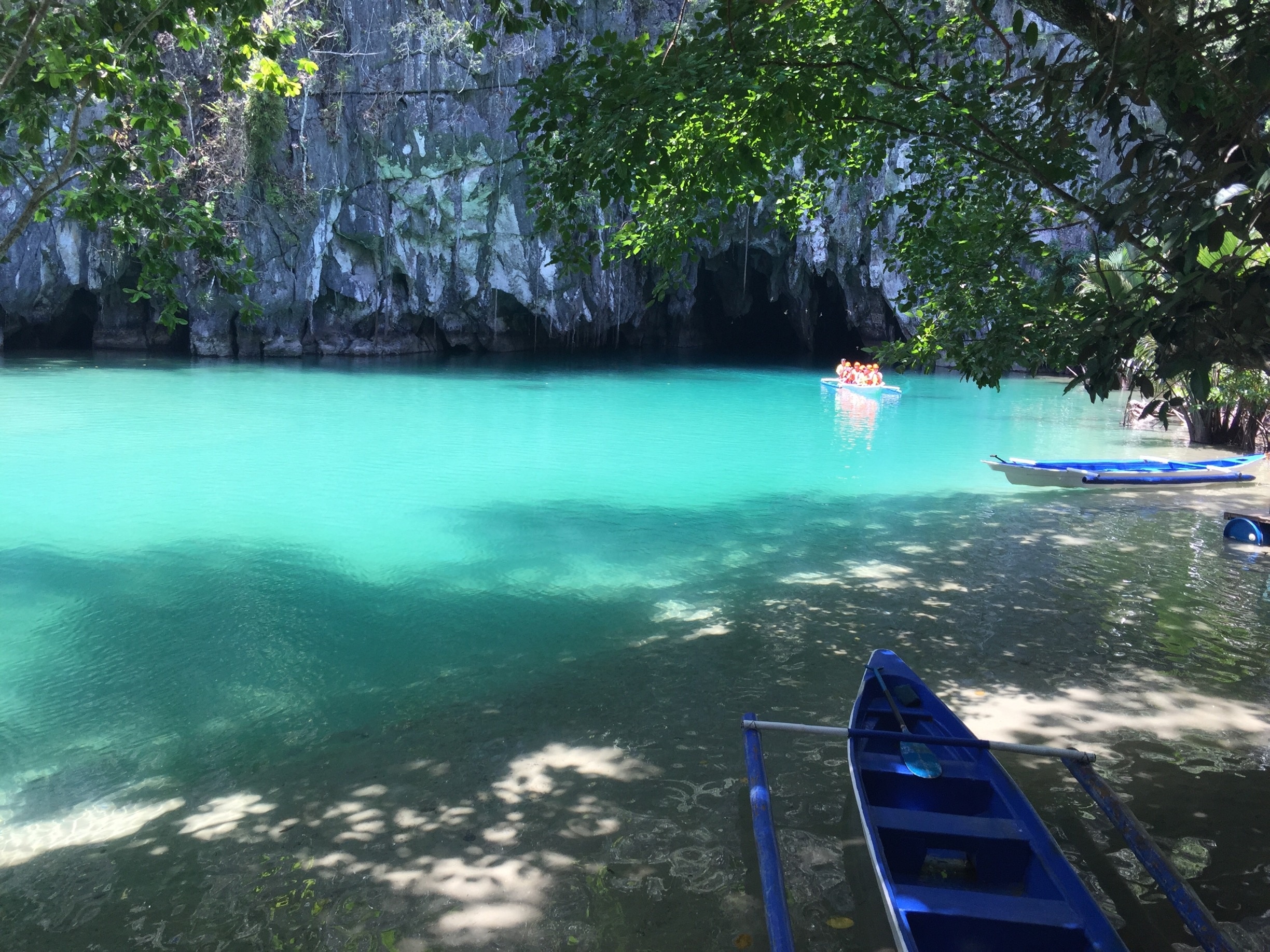
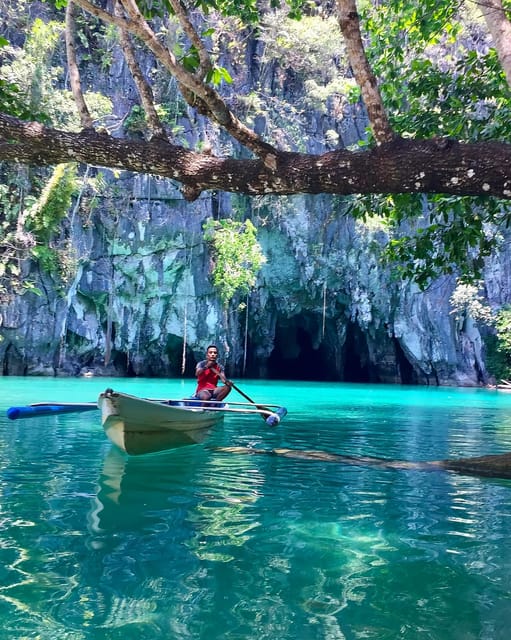
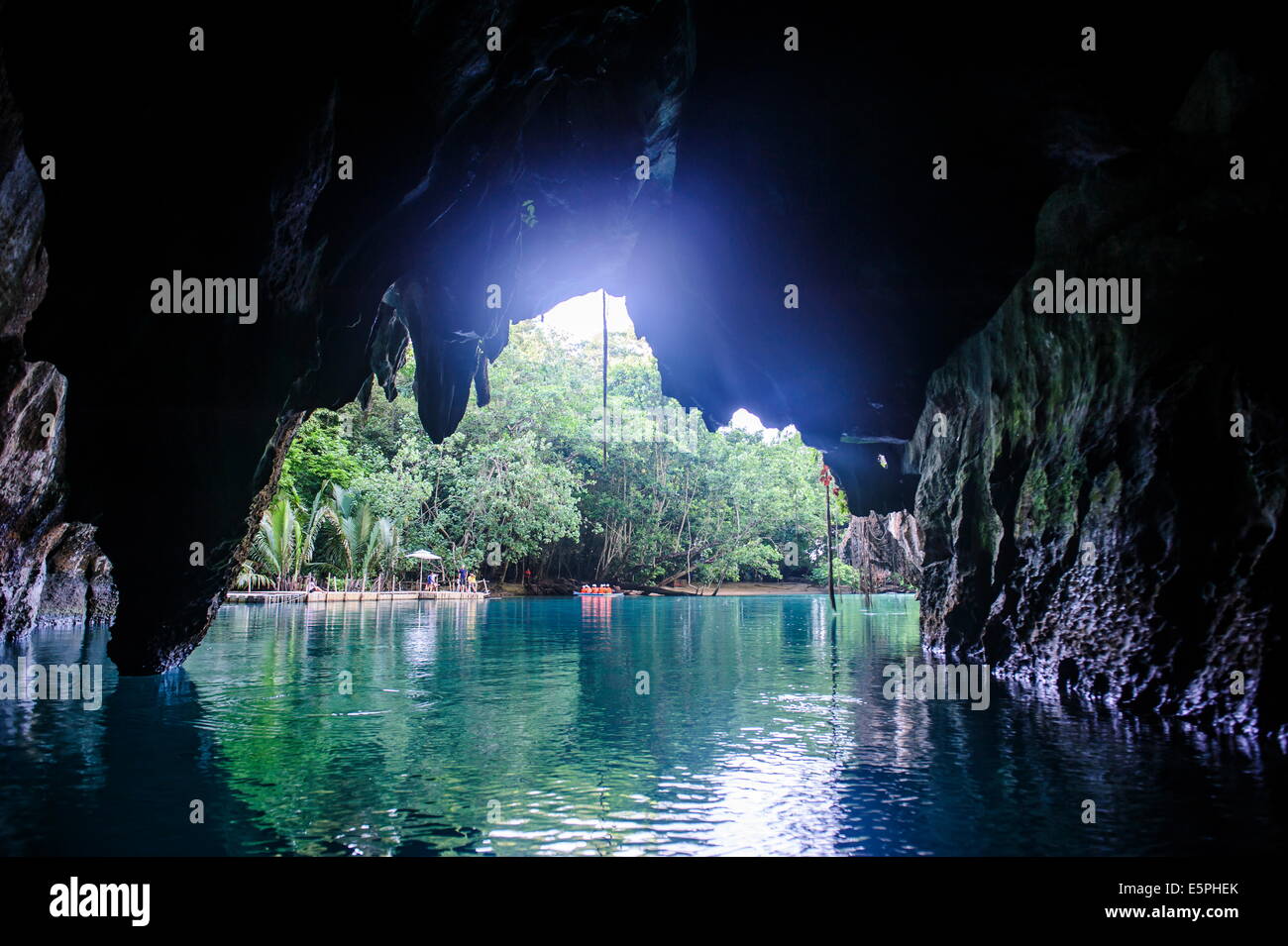
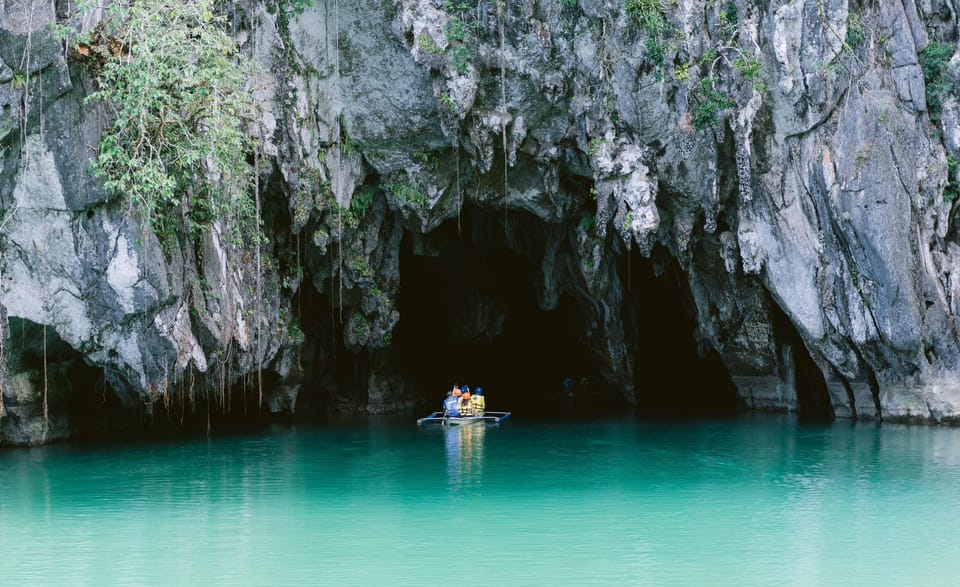
Some tourists who come to Puerto Princesa visit the Puerto Princesa Subterranean River National Park, one of the New7Wonders of Nature, located 50 kilometers (31 mi) north of the city. The city is also the jump-off point for exploring the Tubbataha Reef.
Transportation
Air
The Puerto Princesa International Airport is within the city proper. Puerto Princesa is accessible by direct flights to and from the major cities of the Philippines, such as Manila, Cebu, Davao, Iloilo, and Clark, as well as other parts of Palawan, such as Cuyo, Busuanga, San Vicente, and El Nido.
Sea
The city is served by domestic passenger ferries to Cuyo, Manila, Coron and Iloilo at the Port of Puerto Princesa.
Land
The main modes of transport are via tricycles, jeepneys and vans-for-hire (or PUVs/public utility vehicles). Taxis started operating since April 2015, plying through the city center and nearby tourist destinations. Provincial buses and jeepneys operate from the San Jose terminal located 7 kilometers (4.3 mi) north of the city center off the National Highway.
E-tricycle
Then-Puerto Princesa Mayor Edward S. Hagedorn unveiled the environment friendly and economical electric-powered "Trikebayan" (which does not emit any noise or carbon monoxide) at the Kapihan sa Sulo forum, Sulo Hotel, Quezon City. The Trikebayan costs only ₱48 or $1.20 per day to operate, while a gasoline-powered tricycle operation would cost ₱200. Rolly Concepcion, who conceptualized the Trikebayan, said that converting a tricycle engine to electric costs ₱68,000. The rechargeable battery under the passenger seat can run for 12 hours. There was a dealership for these trikes on the north highway but it closed down in 2011.
Although Puerto Princesa has this bold plan for electric vehicles, the municipal government and tourist office has stated (when asked by a tourist in August 2011), that it has no published or announced plan for providing for the current and future needs and safety of pedestrians or bicycle riders. Spaces for walking and bicycling from one place to another are not being considered.
Healthcare
Hospitals in the city include:
- MMG-PPC Cooperative Hospital
- Ospital ng Palawan
- Palawan Adventist Hospital
- Palawan Medical City
- PuertoGen Clinics & Infirmary
- Ace Hospital
Government
Elected and appointed public officials have governed Puerto Princesa, with a strong mayor-council government. The city political government is composed of the mayor, vice mayor, ten councilors, one Sangguniang Kabataan (SK) Federation representative, an Association of Barangay Captains (ABC) representative and Indigenous People's Mandatory Representative (IPMR). Each official is elected publicly to a three-year terms.
The following are the current city officials of Puerto Princesa:
- House of Representatives Congressman: Edward S. Hagedorn (PDP-Laban)
- Mayor: Lucilo R. Bayron (PDP-Laban)
- Vice Mayor: Maria Nancy M. Socrates (Aksyon Demokratiko)
- City Council Members:
- Matthew K. Mendoza
- Peter Q. Maristela
- Victor S. Oliveros
- Jimmy L. Carbonell
- Elgin Robert L. Damasco
- Nesario G. Awat
- Patrick Alex M. Hagedorn
- Roy Gregorio G. Ventura
- Henry a. Gadiano
- Herbert S. Dilig
- Francisco R. Gabuco (Liga ng mga Barangay President, Ex-officio Member)
- Johnmart M. Salunday (Ex-officio Member, Indigenous People Representative)
- Karl Dylan Aquino (Pres., Sk Federation, Ex-officio Member)
Media
Television networks
All of the major television broadcasting channels' regional offices are located in the city. ABS-CBN Corporation expanded its network in Palawan by establishing ABS-CBN Palawan, which operates ABS-CBN channel 7 Puerto Princesa, ABS-CBN Sports and Action Palawan DYAP-AM and MOR! Local shows such as TV Patrol Palawan are broadcast throughout the region via ABS-CBN Regional, which is also stationed in the city. Bandera News Philippines's airs shows via channel 40 Local Shows Such as Alerto 38, GMA Network's channel 12 and GMA News TV channel 27 are also available.
Cable and satellite TV
The city's cable and satellite TV companies include Puerto Princesa Cable Television (PPCATV)
Radio stations
Puerto Princesa has a number of FM and AM radio stations, some of which operate 24 hours daily.
Twin towns and sister cities
Local
- Quezon City, Metro Manila
- General Santos
International
- Haikou, Hainan, China
- Hsinchu, Taiwan, since February 10, 2006
- Maui County, Hawaii, USA, since March 5, 1999
Notable personalities
- Daryl Ong – singer
- Raul Mitra – composer
- Ramon Mitra Jr. – former House Speaker
- Abraham Kahlil Mitra – former Governor of Palawan and Games And Amusement Board Chairperson
- Samantha Bernardo - Beauty pageant titlist (Miss Grand International 2020 - 1st Runner-up, Bb. Pilipinas Grand International 2020, Bb. Pilipinas 2018 and 2019 - 2nd Runner-up)
Notable organizations
- Centre for Sustainability PH, Inc.
- Palawan Council for Sustainable Development
- Roots of Health
Notes
See also
- Naval Base Puerto Princesa
References
External links
- Philippine Standard Geographic Code
- Official City Puerto Princesa website
- Department of Tourism - Puerto Princesa